Showing posts with label Vise tool. Show all posts

Sunday, February 23, 2014

Adjustable Ring Wrapper


I needed some small rings which I could weld onto various things I wanted to hang on pegboard hooks so I got out a vise tool  I had made for this purpose.  It was made to roll rings from 3/16” round rod with a inside diameter of 1/2” using torch heat.

I wanted the new rings to have a somewhat larger inside diameter. so I cut a short length of the right size pipe to use as the mandrel and just tacked it onto the shaft of the original tool.  I then tacked the end of a 3/16” rod to the added pipe section and did the wrapping.  After rolling several rings I cut the coil end-to-end releasing the individual rings and cut the tack to remove the last one.


This one tool can make rings of several diameters by changing the size of the pipe mandrels.

Windlass with three pipe mandrels.
Wrapped coil sliced (from a different jig).

Sunday, January 19, 2014

The Dragon Pillow


I believe it was Mike Smythe Boone who gave me the name for this tool.  I have seen several variations.  

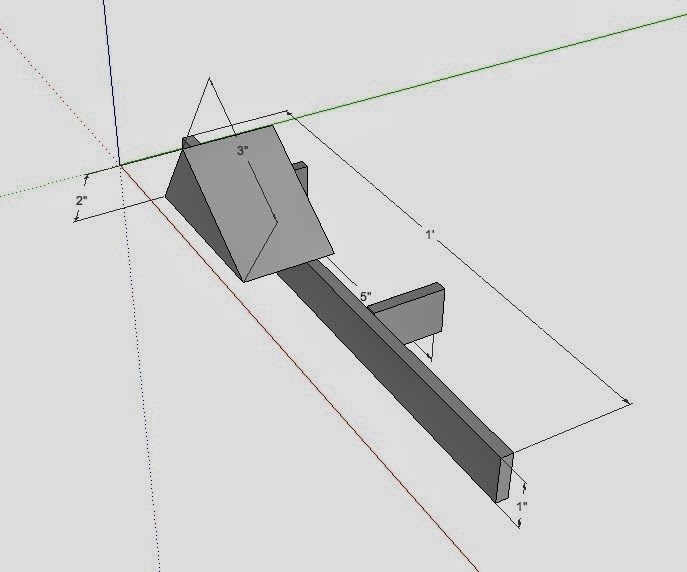
The spine which locks in the vise is a foot long piece of 1/4” x 1” flat bar.  The pillow is made by slicing a 3” long block of 2” square bar on the diagonal. This gives an incline of about 34º to the work face.   The pillow is welded to the spine so that the spine sets in about 3/8” from one side allowing the pillow to rest on the vise jaw.

I use my tool in a 5” vise so I added two short pieces of flat bar to act as stops on both ends on one vise jaw.  I also added a couple of other pieces of scrap which prevent the tool from falling out of the vise when the work piece is removed for another heat.

To use the tool effectively takes a little planning.  If the piece is to be an animal head or a dragon or other figural object the ultimate size will determine the parent stock.  It could be as large as 2” square bar or as small as 1/2” square bar or perhaps a railroad spike.  If I were using 1” up to  2” square, I would cut off as much as I needed and weld on a lighter porter bar.  The vise will grip on the porter bar and not the workpiece itself. 


Figural pieces generally require unite a few heats to forge, chisel and punch all the detail lines so getting a comfortable work layout is helpful.  Even if I was only making a wizard head on a railroad spike I would weld on a porter bar so I didn’t have to use tongs.

My Dragon pillow too.

Dragon by Mike Smythe Boone - Grapevine Ironfest 2001.