Showing posts with label Demonstration. Show all posts

Friday, July 10, 2015

Another Last Demo


In June 2011  I declared I wouldn’t be doing anymore demonstrations out side my shop.  I just didn’t feel up to all the loading and unloading and other work associate with off-site forging.  I parked the trailer in the wooded area north of the studio.  It went unattended until I was persuaded to do another demonstration on a weekend of celebration in the Cottonwood Falls, Kansas area where our artist cooperative gallery is located.  The River Suites event was to be on Friday night and the Symphony in the Flint Hills and the Folklife Festival on Saturday.  The Prairie PastTimes artists decided to put on and open house with some demonstrators.

The first order of business was to get the demo trailer out to pavement so I could inspect it and put everything in order.  Trees had grown up around the trailer and through the tongue so it required chainsaw work to free it.  The tires had sunk into the soil but we were able to pull it out and roll it to the street east of my shop.

I pulled off he rotting tarp and found a wood rat had made a huge nest under the forge pan and has stashed a good supply of Kentucky Coffee Tree seeds in it’s pantry.  Friends helped me pull everything out and sweep before treating the wood plank floor with water seal.  The tires were in bad shape and the wiring to the tail lights didn’t work.  Two new tires were mounted and the wiring was replaced.
I still knew I needed help on the day of the demonstration so I called on a friend, the amazing Scott Miller, who has helped me with so many things over recent years and along the way has become a very talented blacksmith although he has little time to devote to it.  He agreed to help and on the big day did most of the forging work so I mostly just stool around and talked with visitors.

I wanted to work on “light-duty” items as it could have been a very hot day and we did’t have shade over the work area.  Additionally, rain was forecast so we had to be prepared to do something indoors in that case.  I decided we would work on forging various animal heads.  I could show the steps with modeling clay while Scott did the forging.  In case of rain I could do the same thing indoors and there would be no forging.  Also, I packed  some Show and Tell items.


After a week of dodging rain, organizing, repairing and packing, the  demo day arrived.  I was up at 0330 and it was raining heavily.  Scott came at 0630 and the rain stopped.  We did the final loading and drove to the gallery.  It took about a hour to setup and we were ready to forge at 0900 as promised.  Then we learned that the weather forecast had been so unfavorable that some of the Folklife Festival demonstrators had backed out so it had been cancelled.  They were supposed to have a blacksmith working also.

During the morning hours there were fewer visitors than we had expected but the weather continued to improve.  In the afternoon it was clear and there were lots of visitors strolling up and down the two-block long brick-paved Main Street.  The symphony worked out well too.

Optimistically, that was actually my last demo, but, I suppose I should never say never.  


One of our artist members, Eric Dyck, is a talented photographer among other things.  He took a lot of photos during the activities and posted some of our blacksmithing on the web here. Scroll down to June 14th to see the images. https://www.facebook.com/PrairiePastTimes  

Friday, August 19, 2011

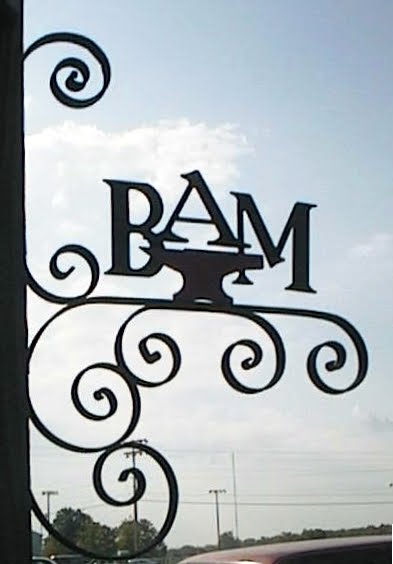
The BAM Tent


We’re back home after a short working vacation. Once again working two days in the demonstration tent of the Blacksmiths Association of Missouri was a pleasant break in the routine and, as expected, I learned a thing or two.


The weather cooperated by bringing two very mild temperature days which are hard to come by in August. We were able to spend time with long-time friends, not so long-time friends and family. The main plan was to work on my offset tongs but, as usual, we wandered off on another project proposed by a visitor. It was entirely predictable that we would not have the stock or tools best suited to the job so work-arounds must be devised.


As a learning experience, the challenge was a success. As a functional object, the creation was a success. As an example of skilled craftsmanship, we came up a bit short. This all served to reinforce what I learned from a demonstrator several years ago and have come to think of as the “first law of demonstrating” - do what you already know how to do.


http://www.persimmonforge.com/

Monday, August 15, 2011

Off to Join the Circus


Well, it hasn’t come to that yet, but tomorrow I am off to enjoy the Missouri State Fair in Sedalia, Missouri, and work/play in the Blacksmiths Association of Missouri demonstration tent. This annual event is a favorite part of my year; I'll be away from the blog for several days. When my father mustered out of the Army Air Corps in 1946 we settled in Sedalia. That was where I grew up from age 3 to 18.


We have dear friends in Sedalia who give us a place to nest and good food and conversation. Every visit has built more lovely memories and complement those which date back to elementary school and even preschool days in Sunday school.


When I was living there, State Fair week seemed to coincide with my birthday, August 27th. But school starts earlier in the calendar now. Part of my birthday present used to be passes to the races for me and several friends. We could count on hot weather, a drought-breaking rain and sometimes a severe storm. I could go on for quite a while with memories of The Fair.


In the days preceding our trip I must decide what to pack. I’ve pretty much given up on trying to construct a “crowd pleaser.” It’s a lot more like a reception line than a static audience so the vast majority of visitors see what they want to see in less than a minute. A few will linger to ask questions and the oddball, potential blacksmith, will hang around and try to learn something. Those few will be offered the possibility of joining BAM and opening the gateway to eternal happiness. Well, again, I may exaggerate.


Back to the packing issue. After quite a bit of experience with this sort of thing, I now pack what I will need to accomplish what I would be doing in the shop anyway. Off and on I work on improving my workspace. Recently I looked over the tong racks in the forge room and concluded there were about twenty pair which were used frequently and another fifty which may not have moved in the past few years.


I removed all of the archived ones, looked them over, and concluded that most could be converted to useable tools. Most were odd shapes, too heavy kludges which I picked up for about $5 apiece at flea markets in the early 90’s. I took out the rivets and prepared them for reforging.


Over the years I have become picky about tools and have firm preferences. In tongs I have a very specific style of offset tongs which I like. I acquired a set of about eight round stock tongs sized from about 1/4” to 1” in an eBay auction about 15 years ago. It may have been the best auction purchase I ever made. At the time I didn’t realize I had purchased anything as unique as it was. I have been to a lot of shops and studied all the tongs offered by the big suppliers and have never run across this style; however, as I pondered my “ideal” tongs, I felt these were not quite on the mark. I had come to like the feel of the ball finial on the reins of a couple of manufactures tongs and decided this feature should be added. Moreover, a ring could be superior to a ball as it could accommodate a hasp or link catch as an alternative to a tong clip when used in a specific production run.


Now, I had a Fair Week project. It is hard to find the time for a couple of days of experimentation. It feels like a luxury extravagance in the work week but can be excused during Fair Week. On Saturday my student assistant, Scott, came and we pounded out enough tong blanks to see me through.


I’ll post a detailed description of my method of making tongs later but this is an introduction. I use 3/8” x 3/4” hot rolled flat bar stock. The blank is 13” long for the average pair of tongs. A couple of inches shorter will make nice light weight tongs for 1/4” stock and a couple of inches longer will make suitable tongs for 1” stock.


In almost every project I try to enhance my convenience in the first heat. This may be, (1) add two plane volume, (2) draw length, or (3) add a convenience bend. If I have a blank and have added two plane volume (potato chip form) as the first step, I can easily pick it up off the floor with pick up tongs rather that chase it around flat when dropped. Drawing length first adds a handle. A convenience bend facilitates localizing the heat. This power to bend and unbend at will is one of the great aspects of blacksmithing.


In this case, I wanted to prepare my blanks so I could work at the fair in a casual manner with hammer on anvil doing the refined jaw work. I decided to do the reins drawing in the shop with my power hammers to save time, effort and perspiration. Each reins segment was drawn out to 3/8” round in two heats. This left a great handle which can be drawn to full length with at 5/16” stop later when I am back in the cool shop.


It could be pretty hot on those demonstration days and I believe in the slogan, “Never let them see you sweat.”


http://www.thisdayinquotes.com/2010/06/never-let-them-see-you-sweat-was.html


http://www.persimmonforge.com/

Sunday, June 12, 2011

The Last Old Time Demo


Yesterday Ken and I set up my collection of blacksmithing tools which represent the late 1800's and did a short three hour demo to augment the activities of the Symphony in the Flint Hills event.
See http://www.symphonyintheflinthills.org/

The location was on the grounds of the historic Richard Howe house, a two story Welsh farmstead completed by the stonemason owner in 1867. It is constructed with eighteen-inch thick limestone walls. The interior has a parlor fireplace, black walnut woodwork, native oak floors and some original furniture, china and clothing.

This early settlement house has been preserved in its near original condition by three generations of the Howe family who occupied the home for 140 years. It was listed on the National Register of Historic Places in 1986. The 15 acre property was willed to the Lyon County Historical Society in 1995 by Sarah Howe, the granddaughter of Richard Howe. The homestead also includes a well, low stone walls, and a barn, which contains a collection of antique farm tools and masonry equipment. The house is open for tours by appointment.

A couple of links:
http://www.prairiepathways.com/Howe_House/
http://kansasflinthills.travel/sites/richard_howe_1860s_welsh_farmstead

We set up, as usual, under the shade of a large tree covered with virginia creeper near the barn. In the time allowed we never seem to get much completed even though we bring all the pieces and tools needed for a couple of period items. Yesterday it was a hearth kettle tilter and sawtooth trammel. We displayed some cooking utensils, fat lamp and dinner bell set made on other occasions.

Our demonstration was the fifth one we have done at this site and ends a ten-year string of similar shows. I have decided to decline future invitations although I will continue to demonstrate in the studio.

It has been mostly enjoyable, working outdoors, visiting with the spectators about the history and techniques of the craft and showing the basic processes. There have been some unpleasant days of drenching rain, oppressive heat, or pesky wind, but the real limiting factor is the difficulty of loading, transporting to the site, unloading and setup, loading again and transporting home and finally unloading again. All this takes a lot of heavy lifting and the better part of three days.

These are unpaid, public service events. They have become very tiring as advancing age erodes physical power and they have never garnered much profitable business. More than anything, I think, they have preserved some interest in the craft and I can always identify with the person who comes up and remarks that the smell of the coal fire is a pleasant reminder of such and such from their childhood. Nostalgia is a sweet treat.

Friday, April 22, 2011

Good Help


A long time ago someone told me. "If you're looking for a helping hand you'll find one at the end of your arm." Certainly, self sufficiency is a trait we're all expected to develop, but when the job exceeds my ability I still have to ask for help.

As soon as I acquired a forge, anvil and a few tools I started getting requests to do old time demonstrations for various historical celebrations. A friend and organic chemistry professor, Ken, stepped up and offered to help me and ever since he has been available when needed. He's developed good blacksmithing skills and comes many days for two or three hours.

My wife, Betty, has helped in the studio from time to time, too, but mostly she takes care of correspondence, billing, packing, shipping and other management aspects of the business.

As a result of layoffs, so prevalent in the economic downturn, I acquired the help of Hector, a certified welder with many years of experience and also young and strong. For a few years he could come most week days for several hours and build equipment which allowed me to take on some larger jobs. It a big loss for me when he returned to live in California again last winter.

On some weekends and nights my friend, Scott, comes to work in the studio and has also helped with some demonstrations. He is in the young and strong category, too, and has a penchant for organizing and cleaning. His grandfather was a blacksmith and he is learning the skills to carry on the tradition.

Recently I was visiting with friends at a local engineering company and was asked about how I got a ton of coal out of my pickup and into the coal bin. I said I used the amazing Scott Miller machine, they are well acquainted with him and the comment got a good laugh.

It's true, I've benefitted a lot from good help and I hope it continues. In addition to the obvious assistance with the work the socializing and conversation is really enjoyable.