Showing posts with label in-line . treadle hammer. Show all posts

Wednesday, March 12, 2014

Another Treadle Hammer Modification


Back on 2/2/12 I wrote about how I designed a modified anvil for my treadle hammer to facilitate drifting and punching an other such work.


Yesterday I was using it to sink some rather deep being in 7 gauge sheet pieces which had some volume.  They were destined to become bowls.  It quickly be came apparent that the handle on the hammer was getting in my way and I wished I had the foresight to make the handle removable.

Most of the time it comes in handy and this is the first time I can recall  that was a real problem and a potential safety hazard.  I reviewed the original plans and it looks like I placed my handle somewhat more forward than the plans show.  It seems more comfortable to me but the position may introduce this potential obstruction difficulty.  It looks like something for a new builded to study closely.

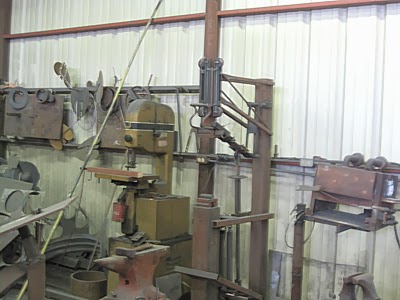
I looked for images and it seemed that most of the hammers had left off the handle.  I found these two images which I think show the position in the original plans.  The images are at this address:


Thursday, February 2, 2012

My Treadle Hammer Anvil for Drifting


During the summer of 1999 I built my In-Line treadle hammer from plans ordered from Clay Spencer. I was planning to make a few hammers at the time and thought the power hammer would be a big help. Almost immediately I decided to modify the anvil construction so it would accommodate the hammer eye drifting.


For the drift to escape a solid anvil wouldn’t work. The drift would need an escape route so I drew up a fabrication project which would build the anvil mass in five layers. The center layer would be composed of pieces of 1” square bar so their arrangement would create the drift escape chute. The other layers would be cut from 1” x 5” flat bar and there would be a 1” thick cap plate with a 1” square center hole.


It all went together well. In addition to the MIG weld beads accumulating the layers I bent and welded two 1/4” x 1” straps around the bundle for an extra measure of strength.


I’ve used it almost every day for 12 years and never had a breakdown. Yesterday I used it to finish making a dozen 9/16” rivet holes in 1” square bar for some table legs. I’ll describe my method in another post because it is a bit different from the usual “slot punch-upset to open-drift round” method.


At the time I built my hammer it stood in an open space which I could walk around and now it is angled into a corner. The drift outlet is on the back side which makes retrieving the drift a bit inconvenient. That’s one place a long handled magnet comes in handy. If I were building a treadle hammer today I’d place the outlet on the right hand side and build a little catch tray to capture the drift. It could cool there and be close at hand ready for the next use.


So, if anyone ever asks me what I’d do differently if I had my life to live over, I suppose I use that line.


http://www.persimmonforge.com/